
NDAA-compliant security cameras: distributor checklist
Updated
Missing camera evidence can delay order approval. Check exact models, OEM and SoC origins, declarations and system scope before ordering.
For NDAA compliant cameras, request a dated manufacturer statement that covers the exact SKU and hardware revision, identifies the actual OEM and explains relevant component origins. Match it to the distributor’s quote, then have your contract owner review the applicable Section 889 requirements and the whole system. A badge, country of assembly or directory listing cannot supply that evidence.
This checklist is for US security-camera buyers preparing a distributor order. It provides a visible evidence matrix, a downloadable blank record and a supplier request you can copy. Start with the security camera distributor research guide for channel selection; use this page to document the proposed hardware before purchase.
Set the scope before asking for a compliance letter
Ask the person responsible for the contract to identify the clauses, intended use and funding conditions that govern this purchase. Section 889, FCC equipment authorization and a manufacturer’s declaration answer different questions. Keep a separate record for each.
Scroll horizontally to see all table columns on smaller screens.
| Input or item | Rule or source | Buyer action |
|---|---|---|
| Equipment supplied to the federal government | Section 889(a)(1)(A); FAR 52.204-25(b)(1), effective August 13, 2019 | Review whether the offered system uses covered equipment as a substantial or essential component, or critical technology; record any applicable exception or authorized waiver. |
| The contracting entity’s own use | Section 889(a)(1)(B); FAR 52.204-25(b)(2), effective August 13, 2020 | Route to the entity’s contract owner. The review can extend beyond equipment used to perform the federal contract; a new-camera declaration alone cannot answer it. |
| Equipment authorization in the US | 47 CFR 2.903, current eCFR text reviewed October 19, 2026 | Check the applicable authorization record and current Covered List scope separately. An FCC ID, where applicable, is not a Section 889 procurement decision. |
| Grant, subcontract or private specification | The actual award, flow-down clauses and buyer specification | Identify the governing requirement rather than assuming the federal prime-contract entity-use rule applies unchanged. Obtain project-specific review where scope is unclear. |
The statutory video-surveillance definition names Hytera Communications, Hangzhou Hikvision Digital Technology and Dahua Technology, including subsidiaries and affiliates, for specified public-safety, government-facility, critical-infrastructure and national-security purposes. Huawei and ZTE appear in the telecommunications definition. Use the full Section 889 text, including its conditions, rather than treating every product made in China as covered.
Trace the seller SKU to the actual OEM and SoC
Ask the distributor to map its order code to the manufacturer’s full model number and hardware revision. An OEM is the original equipment manufacturer; a private-label brand can sell equipment made by another company. Obtain the producer’s legal name and an explanation of any relevant subsidiary, affiliate or manufacturing relationship.
For an IP camera, request the system-on-chip (SoC) maker and part number, plus the manufacturer’s explanation of other relevant processing and communications components. A SoC integrates processing functions on one chip. Put the provenance response against the offered hardware revision; an old product-family letter may not resolve a changed board.
Current FCC 47 CFR 2.903 addresses covered equipment and specified incorporated components, including a conditional rule for logic-bearing hardware from Covered List entities. It extends across certification, supplier’s declaration of conformity and otherwise-exempt equipment. This is a separate authorization check; do not reduce it to a country-of-chip checklist or infer permission from the absence of an FCC ID.
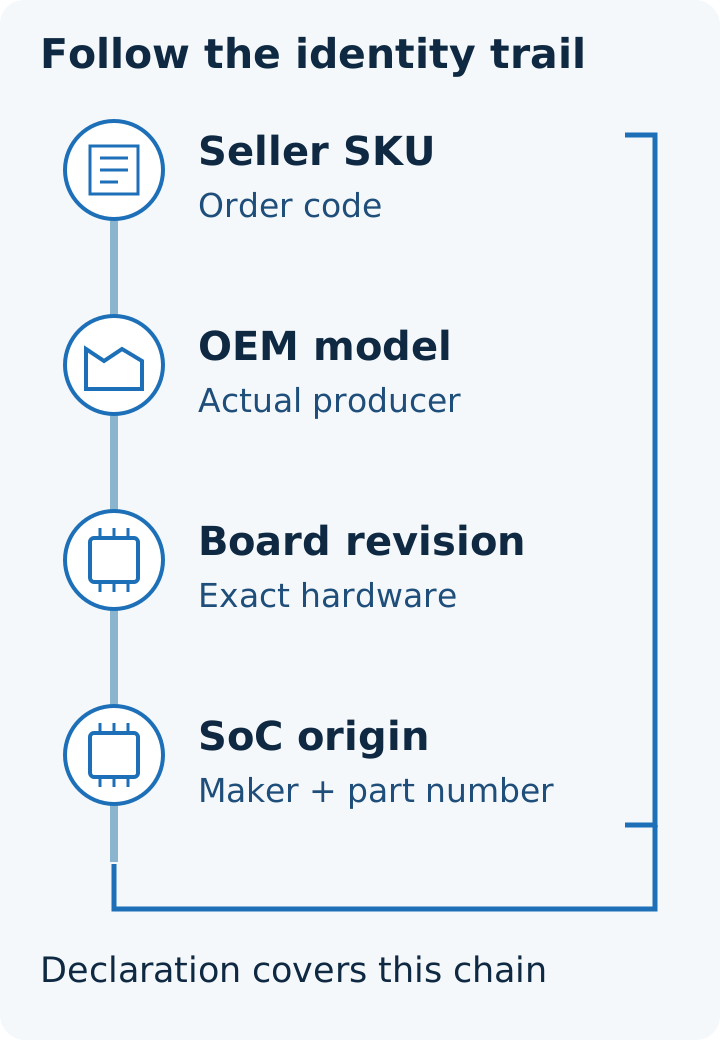
If a supplier will only disclose sensitive component details privately, arrange review through your procurement or compliance owner. Keep the row open until that reviewer can assess the evidence. Do not publish confidential bills of materials or dismantle a camera as a substitute for a documented manufacturer response.
FAR 52.204-25 defines a substantial or essential component by its necessity to proper function or performance. It supplies no universal allowed chip-content percentage. Its reasonable-inquiry definition also excludes the need for an internal or third-party audit; an exhaustive teardown is not automatically a FAR requirement.
Complete the distributor evidence checklist
Create a record for each distinct model and revision, including the recorder and any replacement option. Enter the document URL or filename, its date, the reviewer and an unresolved question beside each check. Use Hold, Needs clarification or Ready for contract review as working dispositions; none is a certification badge.
Download the blank camera evidence checklist or copy the rows below into your purchase file. The CSV includes fields for evidence references, document dates, reviewers and dispositions.
Scroll horizontally to see all table columns on smaller screens.
| Check | Evidence to attach | Your record / disposition | Dominant Failure Mode & Prevention |
|---|---|---|---|
| Contract scope | Clause, use, funding source and responsible contract owner | To complete | Wrong rule applied; have the owner define the review boundary. |
| Seller and order code | Legal seller, quote reference, full regional SKU and quantity | To complete | Declaration covers another unit; match quote and manufacturer model. |
| Actual producer | OEM legal name, private-label mapping and relevant affiliate explanation | To complete | Brand-only screening misses the producer; resolve manufacturing identity. |
| Board and SoC | Hardware revision, SoC maker/part number and relevant component provenance response | To complete | Board substitution breaks the evidence chain; bind the response to revision. |
| Manufacturer declaration | Dated issuer statement with model/revision scope and exclusions | To complete | Undated family badge substitutes for evidence; obtain the applicable document. |
| System and services | Camera, recorder, network equipment and surveillance-service schedule | To complete | Camera review overlooks another supplied item; review the whole proposed scope. |
| FAR representation and FCC check | Applicable offeror representation; separate authorization and Covered List review record | To complete | One document is mistaken for both checks; record each conclusion and owner. |
| Shipment and replacements | No-substitution term, packing record and received model/revision match | To complete | Approved quote differs from delivery; hold unmatched units and re-review replacements. |
Example disposition, with hypothetical identifiers only: quote Q-EXAMPLE lists CAM-EXAMPLE revision B, while the attached declaration covers revision A. Record ‘Needs clarification: obtain revision-B scope from the manufacturer’; the matching brand name does not close the row. These identifiers describe no offered product.
An offeror’s representations under FAR 52.204-26 address providing and using covered equipment; the provision also directs review of SAM excluded parties. FAR 52.204-24 addresses applicable offer-specific representations and disclosures. Follow the actual solicitation’s completion instructions. A distributor’s SKU letter does not replace the offeror’s representations.
Review the system and control substitutions at receipt
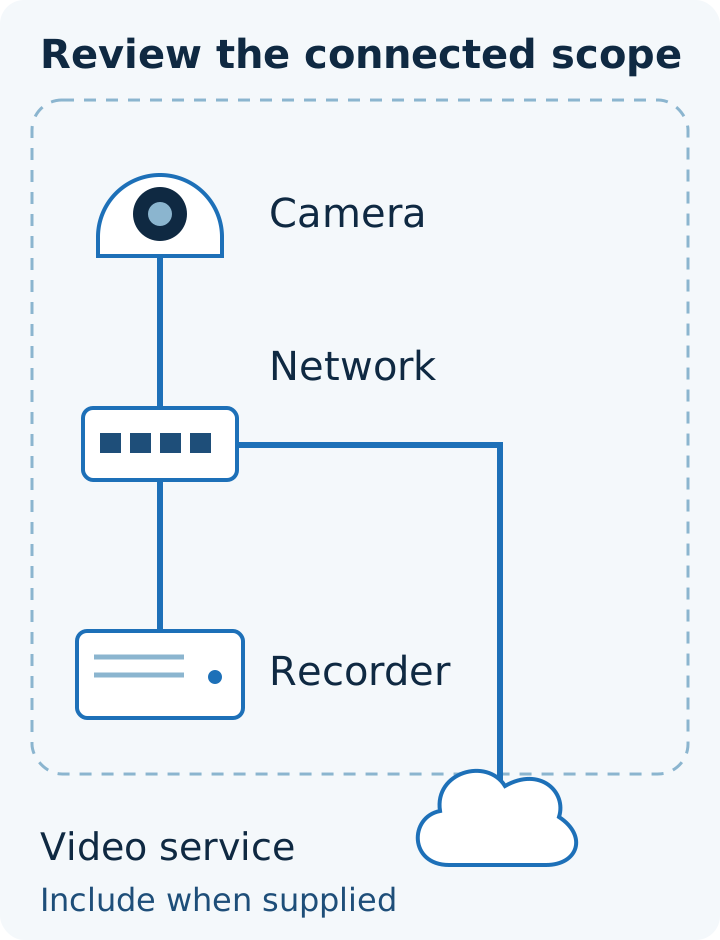
Include recorders, encoders, relevant network hardware, hosted video and surveillance services in the review boundary defined by the contract owner. For the upstream network, keep a separate networking supplier record and connect it to the same project file. A camera’s declaration cannot establish the origin or service provider for everything attached to it.
Use a practical release rule: if even one required identity or declaration match remains unresolved, hold that order line for review. Zero unresolved rows is a buyer’s document-control criterion, not a statutory numeric test. A familiar brand, authorized channel or functioning video stream does not close a component-provenance question.
Put the approved model/revision schedule and substitution-review requirement into the order. At receipt, compare labels and packing records with that schedule before installation; send mismatches back to the purchasing owner. Record changes to replacement hardware and service providers in the same file.
If covered equipment is identified during contract performance, follow the contract’s reporting route promptly. FAR 52.204-25(d) calls for an initial report within one business day of identification or notification, and further available mitigation information within 10 business days after that initial report. Do not wait for a seller’s replacement before alerting the responsible contract owner.
Budget review time and rework over the same purchase window
Compare quotations through receipt and acceptance, using the same system scope and labor rates. Keep documentary review, installation rework and replacement equipment on separate lines so that a low hardware quote does not hide a second installation visit.
Review hours = (distinct model/revision lines × minutes per line ÷ 60) + escalation hours. Worked example with assumed inputs: 12 lines × 15 minutes ÷ 60 + 1.5 hours = 4.5 review hours. These are planning inputs, not required review times or evidence that a review is complete.
If a hypothetical mismatch requires replacing 8 already-installed units at 0.75 labor hours each plus 2 restaging hours, additional labor = 8 × 0.75 + 2 = 8 hours. Apply your own labor rate; do not infer an expected saving or probability from this scenario.
Scroll horizontally to see all table columns on smaller screens.
| Cost line | Input to obtain | Keep out of double counting |
|---|---|---|
| Initial purchase | Same approved cameras, recorders, licenses and freight scope | Exclude a replacement already credited in the return terms. |
| Evidence review | Review hours × your procurement/compliance labor rate | Separate ordinary review from unresolved-issue escalation. |
| Replacement and returns | Uncredited hardware, freight and handling under the quoted terms | Use actual return/credit terms; no assumed vendor guarantee. |
| Rework and restaging | Additional labor hours × your installation labor rate | Count only extra visits or work beyond the original installation. |
| Delay | Your documented project-delay cost, if applicable | Do not count the same idle labor again as installation rework. |
Total comparison cost = initial purchase + review + uncredited replacements/returns + additional rework + documented delay. Replace the assumptions with your project inputs. The equation supports a purchasing comparison; it does not price compliance risk or predict contract consequences.
Send a precise evidence request to the chosen distributor
Copy this request into your own supplier correspondence: ‘For quote [reference] and project [use/contract scope], provide the full camera and recorder SKUs, hardware revisions, actual OEM legal names and private-label mappings. Attach the dated manufacturer declarations covering those exact items, the relevant SoC/component provenance response and a separate FCC authorization/covered-equipment explanation. Identify exclusions, services and substitution conditions. Mark any item you cannot document so our contract owner can review it.’
Browse security camera distributor records, verify the company’s current public contact route using the distributor verification guide, and send your quote schedule and completed checklist directly to that supplier. Ask it to return the matching documents and unresolved items. Keep full serial numbers and procurement documents in that private exchange.
DistributorIndex manufactures products and maintains this supporting channel reference library. A directory listing is not an authorization, a manufacturer declaration or compliance certification; what a listing means explains the evidence labels. The manufacturer supplies product evidence and your contract owner determines the purchasing disposition.
Method, sources and review date
Reviewed October 19, 2026 against the public original FY2019 NDAA, Section 889, enacted August 13, 2018, at 132 Stat. 1917–1919; FAR 52.204-25, clause dated November 2021; FAR 52.204-24, November 2021; FAR 52.204-26, October 2020; and the current eCFR text of 47 CFR 2.903, displayed as current through October 15, 2026. Clause dates identify the retrieved versions; check the provisions and agency instructions that govern your award.
The evidence matrix and release controls are procurement recommendations derived from those rules. No model is selected or certified here. For a specific contract, grant, exception, waiver or disputed component relationship, ask the responsible contracting/compliance owner to resolve applicability using current official requirements. Check the current FCC Covered List and model-specific authorization status again at the purchase decision.