
Used Cisco license transfer: cost factors and purchase evidence
Updated
Before buying used Cisco gear, see which license, inspection, and support costs Cisco's 2026 transfer policy can add, and what to get from the seller.
A low price on used Cisco hardware does not include the right to run its software. Cisco says the software on used or secondary-market equipment is not transferable unless its Software Transfer and Re-Licensing Policy allows it, and that the buyer must get a new license from Cisco before the software can be used. When no exception in the policy applies, the Transfer License Fee equals the fee for a new individual license in Cisco's then-current GPL for the buyer's territory, and Cisco may add inspection or reinstatement fees. Cisco’s inspections team quotes inspection and relicensing for the specific equipment. The transfer-fee basis is defined in policy version 3.3, dated February 3, 2026.
This guide is for a network buyer comparing a used or secondary-market Cisco quote against a new one. It lists the cost items Cisco's documents name for the software license, shows which transfer scenarios avoid the license fee, and lists what to get from the seller before you pay. DistributorIndex is a manufacturer; this guide is part of our brand and channel resource library. Request license pricing and transfer approval from Cisco for the proposed purchase. If you found the seller on this site's Cisco hub or among networking distributors, read that row as a research record, as explained in what a listing on this directory means.
Does the software license come with used Cisco hardware?
No, unless Cisco's policy allows the transfer. Cisco's Hardware Inspection and Software Relicensing Program page says Cisco hardware may be freely resold or leased, but the embedded software that runs on it, and Cisco standalone software, is not transferable unless the transfer policy specifically allows it. The same page says a buyer of used or secondary-market equipment must acquire a new license from Cisco before the software can be used.
Where a transfer is allowed, the page says you need Cisco's written consent and must pay a license fee. After the transfer, the previous owner's license ends, and the new owner uses the software under Cisco's end user license agreement and the original license entitlement. The page defines secondary-market equipment as equipment bought from a seller that is not an authorized Cisco reseller.
The policy has limits on what it covers. The Cisco Software Transfer and Re-Licensing Policy says it does not apply to Buying Programs, Subscription Offers, or cases expressly excluded in Supplemental Terms or Offer Descriptions. If the seller's license came through one of those, this policy does not settle the cost.
The hardware warranty is a separate matter. Cisco's Hardware Warranty FAQ says warranty or services coverage ends when a product is re-sold or bought on the secondary or “gray” market, and that the product warranty is nontransferable. The Cisco grey market warranty and support checklist covers that side of the quote.
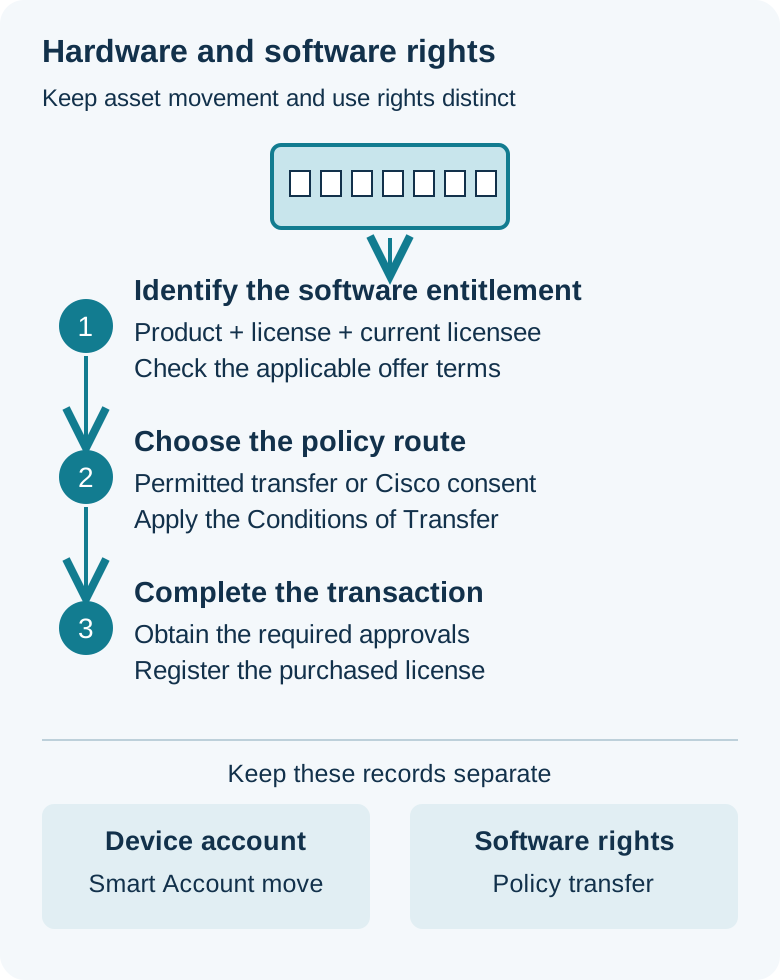
Takeaway: on a used Cisco unit, price the software license as a separate line, because Cisco treats it as one.
Which license-transfer cost factors belong in the comparison?
The policy measures the transfer fee against a new individual license for the same use rights. Section 2.1 allows a transfer in three cases only: applicable law requires it, a Permitted Transfer Scenario applies, or Cisco consents and you pay a Transfer License Fee. The definitions section sets that fee equal to the fee for a new individual license for the same use rights, as listed in the then-current GPL of the Cisco entity in the territory where the transferee is located.
Skipping the license fee does not make the transfer free. The policy says every transfer is subject to its Conditions of Transfer, and that Cisco may require the transferee to pay service inspection or reinstatement fees before it allows any transfer, according to Cisco policies.
The table lists each cost item that Cisco's policy documents name. Fill in the right-hand column from Cisco's own quote. Use the quote’s line items to avoid counting the same license charge twice.
Scroll horizontally to see all table columns on smaller screens.
| Cost item | When Cisco says it applies | How the amount is set | Amount on your Cisco quote |
|---|---|---|---|
| Transfer License Fee | Cisco consents to a transfer that no law requires and no Permitted Transfer Scenario covers | Equal to a new individual license for the same use rights in the then-current GPL of the Cisco entity in the transferee's territory | |
| Inspection and relicensing | Used or secondary-market equipment entering the Hardware Inspection and Software Relicensing Program | Cisco's inspections team quotes both together, after the product passes a preliminary eligibility analysis | |
| Service inspection or reinstatement fees | Cisco may require them before allowing any transfer, including one with no Transfer License Fee | Cisco’s applicable inspection or reinstatement quote | |
| New Cisco support contract | Only after Cisco has relicensed the equipment and it has passed inspection, with proof of a valid software license | ||
| Software contracts on the seller's account | Cisco's Smart Account article says its self-serve transfer does not account for software contracts |
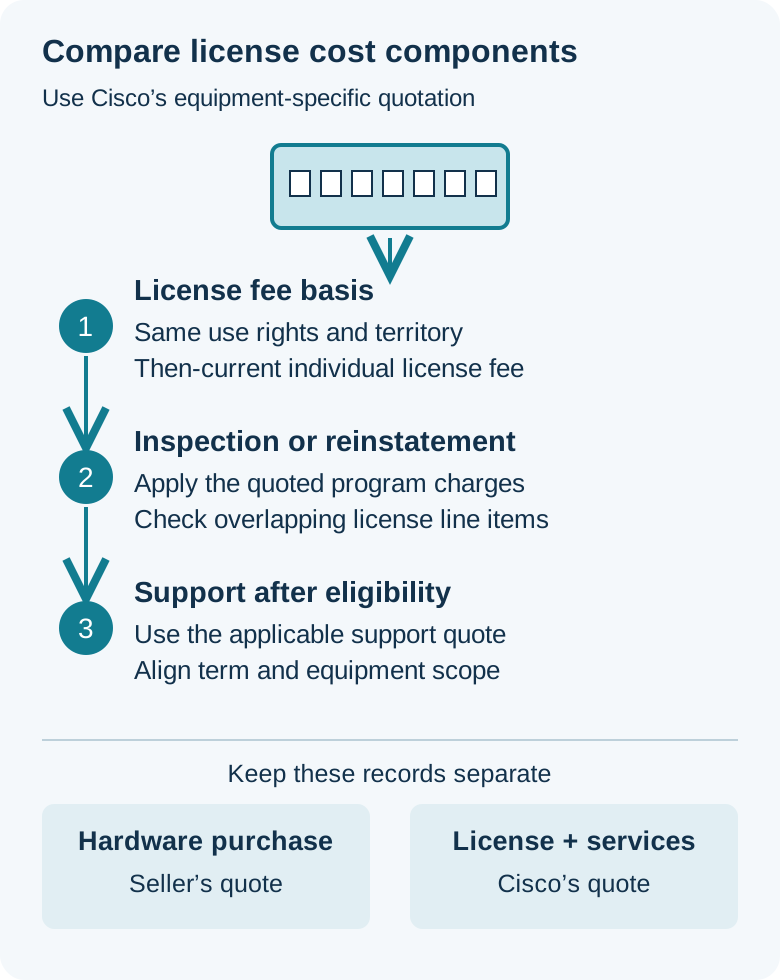
Two lines may overlap: the policy's Transfer License Fee and the relicensing part of the program quote. Cisco's policy documents do not say whether they are the same charge. Check whether Cisco's quote shows them as separate lines before you add one to the other, so the same license is not counted twice in your comparison.
Takeaway: the policy fixes what the license fee is measured against. Only Cisco's quote fills in the amount.
Does your purchase fit a scenario with no license fee?
Section 3 of the policy lists the Permitted Transfer Scenarios. Under section 2.1, a transfer that fits one of them needs no Transfer License Fee. The Conditions of Transfer still apply, and Cisco may still charge inspection or reinstatement fees.
Scroll horizontally to see all table columns on smaller screens.
| Scenario | Condition in the policy | Transfer License Fee |
|---|---|---|
| Affiliate | The use rights go to an Affiliate, as defined in Cisco's General Terms | Not required |
| Merger, acquisition, or divestiture | The licensee is wholly acquired, merges, sells all or substantially all of its capital stock, or sells all or substantially all of the assets of the part of the business where the use rights reside | Not required |
| Financed software, licensee buys the hardware | The licensee buys the hardware during or at the end of a lease or financing and keeps the attached use rights under the original license terms | Not required; the policy says no new license is needed |
| Financed software, financing party takes possession | After a default, the financing party may transfer the hardware and its use rights to a new lessee or transferee for the rest of the Use Term | Not required |
| Managed services, to the original end user | The MSP used the rights for at least 12 months before the request, only to serve that end user under a managed services agreement | Not required |
| Managed services, to a new MSP | The original end user moves to a different MSP for the same or equivalent services, and the transfer is solely for that end user's benefit | Not required |
| U.S. Government prime contractor | A follow-on contract moves the work to a new contractor; the rights were used only for that Government End User, are for its internal use, and the transfer is required by the follow-on contract | Not required |
| Outsourcing | The rights go to an outsourcer and are always used for the original licensee's sole benefit; they return when the relationship ends | Not required |
| Transfers within Europe | Both parties are located in Europe (EU, Switzerland, UK, Norway, Iceland, Liechtenstein); the rights were originally provided in Europe by Cisco or an authorized reseller, are unmodified, perpetual, under a valid license agreement, and used for the transferee's internal business purposes | Not required |
| None of the above | A purchase from a seller where no row fits and no law requires the transfer | Required, with Cisco's consent |
If no row fits your purchase, the policy leaves one practical route: Cisco's consent plus the Transfer License Fee. Whatever the seller says, the scenario has to match the policy text.
Common mistake: reading the Europe row as covering any buyer in Europe. The policy requires both the current licensee and the transferee to be located in Europe, and the rights to be perpetual and originally provided in Europe by Cisco or a Cisco authorized reseller.
Takeaway: a fee-free transfer is a defined exception. Ask the seller which row they claim and what document supports it.
What should you get from the seller before you pay?
The seller's cooperation is part of the cost. Under section 2.2, both the current licensee and the transferee must complete and accept Cisco's Software License Transfer Request Form. For licenses in a Smart Account, the process starts from Cisco Software Central. Section 2.3 adds conditions, and several fall on the current licensee. Neither side may be in breach of a Cisco agreement. The licensee must provide the information the form asks for, and the transferee takes on the licensee's obligations and the same use rights, including license metric, duration, overage charges, and quantity. The licensee must also destroy or delete its copies of the software, confirm that in writing if Cisco asks, and its own use rights end at the transfer.
In its financed-software section, the policy says use rights and obligations exist only between Cisco and the end user identified in Cisco's records as the licensee. If the company selling to you is not that licensee, ask who will sign the Transfer Request Form as the transferor. Whether a seller listed on this site has any Cisco relationship is a separate check, covered in how to verify a distributor listing.
Scroll horizontally to see all table columns on smaller screens.
| Item to request | Why it matters under Cisco's documents | Example format |
|---|---|---|
| Licensee named in Cisco's records | The policy ties use rights to that licensee, and the transferor completes the Transfer Request Form | Legal entity name |
| License type | The policy excludes Buying Programs and Subscription Offers; the Europe scenario requires perpetual rights | Seller's written statement: perpetual or subscription, and any buying program |
| Where the license sits | Asset Transfer Manager needs a source Smart Account, and the person moving assets needs user access to it | Smart Account name or domain |
| Buying and deployment model | Cisco's article says Enterprise Agreement assets and OnPrem-connected devices cannot be moved with the current self-serve tool | Yes or no for each |
| Agreement to sign and delete | Sections 2.2 and 2.3 need the licensee's signature, information, and deletion of its copies | Written commitment from the licensee |
| Scenario claimed | Only a Permitted Transfer Scenario or a legal requirement removes the Transfer License Fee | Scenario name from the policy table, with the supporting document |
| Locations of both parties | The fee is set by the transferee's territory, and the Europe scenario depends on both locations | Country of the licensee and of your company |
| Product ID and serial number of each unit | Cisco's inspection quote is per product, and a purchased license is registered to the hardware's serial number | As printed on the quote and the unit label |
Takeaway: if the seller cannot name the licensee or will not sign the transfer form, the license route has no paperwork behind it, whatever the hardware price.
How does a Smart Account transfer fit in?
A Smart Account move changes where Cisco records the assets. Cisco's article How can I transfer or move Assets (Device, License) between Smart Accounts? (revision 1.0, September 9, 2025) lists three prerequisites: an active Cisco.com account, a valid business justification, and user access in both the source and the destination Smart Account. The move is made in Asset Transfer Manager.
The article's cautions affect what the move covers. Assignment and reassignment always apply to the entire order line. The self-serve tool does not account for software contracts. Assets under an Enterprise Agreement buying model, and devices connected to an OnPrem deployment model, cannot be transferred with the current capability.
For a move to a different legal entity, you select the transferee, and the article says Legal and BP approve every transfer request. It also says device-only transfers proceed without legal intervention. The listed statuses include “Submitted – Awaiting Transferee consent”, “Compliance Screening”, and “Compliance Screening Rejected”, which the article describes as a cancellation by the Cisco Legal Team.
A Smart Account asset move changes the account holding the device record. Transfer of the seller’s software use rights follows the conditions and fee rules in Cisco’s transfer policy.
Takeaway: the Smart Account move is the record. The policy decides whether you hold the license.
When does Cisco Refresh avoid this process?
The relicensing page says customers who want used Cisco equipment but do not want to go through relicensing and inspection can buy remanufactured products through Cisco Refresh. The Cisco Refresh page says certified remanufactured equipment is eligible for the same warranty and support options as new products, and it lists Contact Sales and a partner locator as the ways to buy.
This applies only to equipment bought as Cisco Refresh. A seller's “refurbished” label is not the same thing, as the grey market checklist explains. If you are comparing a used quote with a Refresh quote, the used quote needs the license, inspection, and support lines from the cost table above.
Takeaway: comparing a used quote with a Refresh quote only works once the used quote has its license, inspection, and support lines filled in.
What do you send Cisco to get the amounts?
Cisco's program page lists the steps for used and secondary-market equipment. The inspections team asks for a preinspection checklist covering the inspection site and the equipment. You provide product and network information, including a show tech file, and Cisco says the checklist must be accurate and complete. Cisco then runs a preliminary analysis of eligibility. If the product passes, the team quotes both the inspection and the relicensing. You order with the SKU on that quote in the Cisco Commerce tool. Once the order is validated against the quote, Cisco says it schedules the inspection within 5 business days in the United States and Canada and 10 business days in the rest of the world. After the equipment passes inspection and meets the relicensing requirements, Cisco says it is eligible for Cisco support and services. You then register each purchased license to the serial number of its hardware, using the product activation key sent at purchase.
Email the items in this table to Cisco's inspections team at tss-inspections@cisco.com and ask for the inspection and relicensing quote for each serial number; Cisco says it quotes only after the product passes its eligibility analysis.
Use Cisco’s quoted amounts and eligibility decision to complete the purchase comparison.
Scroll horizontally to see all table columns on smaller screens.
| Item | Why it is needed | Example format |
|---|---|---|
| Product ID and serial number of each unit | The inspection and relicensing quote is per product, and the license is registered to that serial | As printed on the unit label |
| Inspection site | The preinspection checklist asks for it | Site address |
| Product and network information | Cisco asks for it, including a show tech file | show tech output for each unit |
| License type and where it sits | Separates a policy transfer from a new license and flags the excluded programs | Perpetual or subscription; Smart Account name or domain |
| Transfer route | Tells Cisco whether you claim a Permitted Transfer Scenario or need its consent | Scenario name from the policy table, or “none” |
| Seller's licensee status and agreement to sign | The Transfer Request Form needs the current licensee | The seller's written answers from the table above |
Takeaway: the cost table is complete only when Cisco's quote has filled in its right-hand column.
Frequently asked questions
How much does a Cisco license cost?
For a transfer that no exception covers, the policy sets the Transfer License Fee equal to a new individual license in the then-current GPL for the transferee's territory. For used equipment, the amount comes from Cisco's inspection and relicensing quote.
Where can I buy used Cisco equipment?
Cisco names its own Refresh program for certified remanufactured equipment. A company on this site's Cisco or networking pages is a research record, not proof of a Cisco relationship. How to research networking distributors explains how to read those pages before you contact anyone.
Sources and review date
Sources (reviewed October 2026): the Cisco Software Transfer and Re-Licensing Policy (version 3.3, last modified February 3, 2026), the Cisco Hardware Inspection and Software Relicensing Program page, Cisco's Smart Account asset transfer article (revision 1.0, September 9, 2025), the Cisco Hardware Warranty FAQ (updated January 29, 2025), and the Cisco Refresh page.
Check Cisco’s current licensing documents and request the applicable transfer terms for the proposed transaction.