
Deal registration: a channel partner and distributor guide for IT and security projects
Updated
Unapproved discounts can cost your margin. Deal registration connects a channel partner’s scoped opportunity to vendor review and a distributor quote.
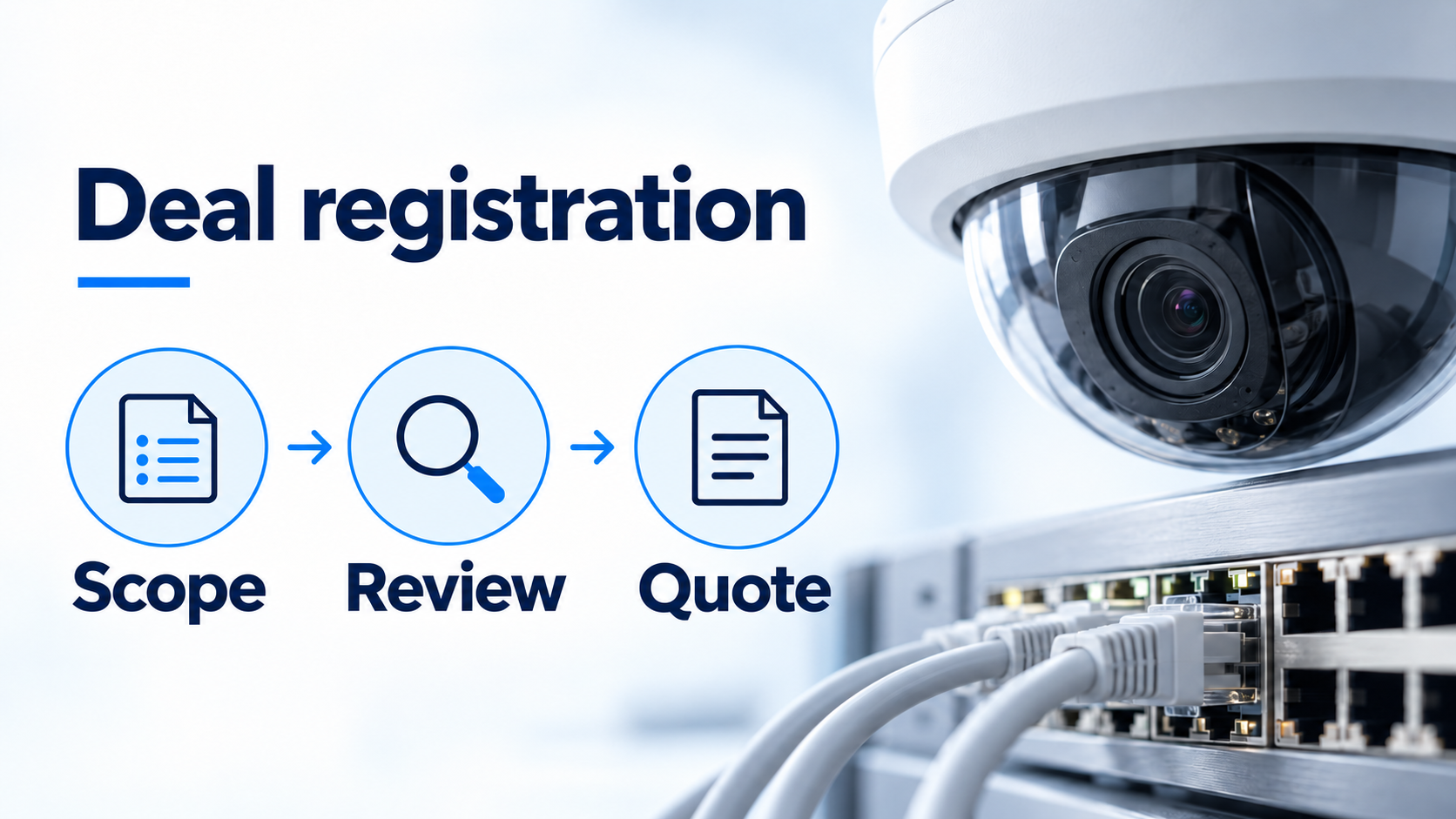
Promising a project discount before approval can leave an integrator funding the difference. Deal registration is the submission of a specific sales opportunity for review under a vendor’s channel partner program; the applicable rules and written decision determine its benefits. For IT and security projects, confirm who is eligible, who submits through the distributor, which customer and equipment scope the request covers, and when the approval and quote expire. Registration alone does not establish stock, a fixed discount, exclusivity against every seller, or regulatory compliance.
This workflow is for system integrators and second-tier resellers preparing a distributor handoff. Use the packet and decision tables below with the current regional program rules. If you still need a supplier shortlist, start with the distributor directory and how to find a distributor.
What does deal registration actually protect?
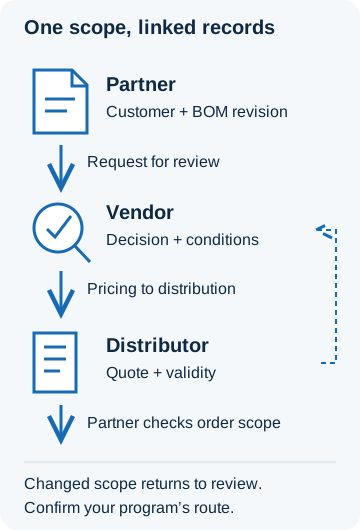
It can recognize a partner’s work on an opportunity and make that opportunity eligible for program benefits. The extent of that protection comes from the specific program. Keep the opportunity approval and the distributor quotation as two separate records.
Axis’s public project-registration guide provides a concrete security-channel example: partners submit project information, Axis reviews each opportunity individually, and a quotation goes to distribution partners. The guide describes competition, system design and integration work as relevant background. It does not publish a universal discount or a guaranteed decision deadline. For the exact BOM route, use the Axis project-pricing handoff guide.
Ask what protection means in your program: preferred project pricing, treatment of vendor direct sales, rules for competing partner requests, or another defined benefit. Ask whether the approval covers the named reseller, end customer, site, product category and delivery territory. A partner tier or buying account is a separate qualification; neither proves that this opportunity has approval.
Scroll horizontally to see all table columns on smaller screens.
| Record | What it answers | Dominant Failure Mode & Prevention |
|---|---|---|
| Partner eligibility | Can this company and user use this program in this market? | Wrong entity or account. Confirm eligibility and permissions with the program owner. |
| Opportunity decision | Has this customer/project/scope been accepted, and on what conditions? | Submission mistaken for approval. Retain the actual decision and conditions. |
| Distributor quotation | What can this buyer purchase, at which terms and until when? | Approved project matched to an expired or different quote. Reconcile line items and validity. |
| Supply and compliance evidence | Does the proposed delivery meet the project’s separate sourcing and contract requirements? | Registration treated as certification. Check the exact supply chain, products and contract evidence. |
Confirm the program and appoint one submission owner
Choose the correct program before sending customer details. Ask your vendor channel contact or distributor to identify the current regional terms, eligible product categories, submission route and company responsible for the record. Save the version or date of those instructions.
Program scope can be narrow. The public Fortinet Federal registration page, retrieved October 19, 2026, limits that form to its Federal Partners and opportunities within the US Federal Government or related entities. That scope does not establish the route for an ordinary commercial project. Likewise, one brand’s approval cannot cover a mixed-brand BOM by implication.
Assign one person to coordinate the packet, with a backup for absences. If the distributor submits on your behalf, ask it to identify your reseller company accurately and return the assigned reference and decision evidence through an agreed private channel. Confirm who can view, revise, renew or close the opportunity. Do not create another request just because a colleague cannot find the first one.
Research the trading company separately using how to verify a distributor listing. A listing’s evidence label does not establish your partner membership or the seller’s authority for every product division or territory.
Prepare a packet the distributor can reconcile
Prepare one current packet with a traceable customer, scope and owner. The table is a recommended working record, not a list of mandatory fields from a private portal. Supply confidential customer information only through the verified recipient’s approved channel.
For Axis Site Designer specifically, the live manual’s Request project pricing section describes a direct route through Axis Partner Web when you have the required access, with the BOM included automatically. It also describes downloading the BOM file and attaching it to a request through your distributor. Confirm the accepted file format rather than assuming that every spreadsheet export can replace the requested file.
Scroll horizontally to see all table columns on smaller screens.
| Item | Why the recipient needs it | Your entry or example format |
|---|---|---|
| Vendor, region and program | Establish which rules apply | Program name; country; terms version/date |
| Reseller and submission owner | Connect the eligible entity to the request | Legal company; partner reference if applicable; named owner |
| Customer and opportunity | Distinguish this project from another request | Customer legal name; site; project description; assigned reference when available |
| Presales work | Explain the opportunity you developed | Factual design/integration/engagement summary; retain supporting records |
| Current equipment scope | Give review and quotation the same baseline | BOM filename, revision, exact product references and quantities |
| Delivery and schedule | Identify territory and timing questions | Ship-to country; requested order and delivery dates; phases |
| Decision record | Separate receipt from approval | Actual status; issuer; conditions; decision date; expiry if stated |
| Quote and changes | Prevent old terms following a new scope | Distributor quote ID/revision; validity; changes since prior BOM |
For a combined camera and network purchase, use security-camera distributor research and networking distributor research to check the relevant channels. Keep each vendor’s reference and decision distinct even when one distributor supplies several lines.
Record the decision and resolve conflicts without duplicate claims
Save the returned status and conditions before you use a benefit in a customer proposal. A receipt or reference proves that a record exists; use the actual program decision to establish approval. If the reply is unclear, ask the program owner what remains outstanding and who must respond.
For a duplicate, competing-partner or customer-identity conflict, assemble the original submission reference, dated engagement evidence, scope and customer/site identifiers. Send a factual correction or dispute through the program’s stated channel. Ask for written disposition and identify which quotation, if any, can still be used. Avoid resubmitting the same opportunity under an altered spelling or another distributor to evade the review.
Keep price discussions separate from assertions about another seller. An approved registration does not, by itself, prove that a competing offer involves diverted goods. Verify that offer’s company, territory, product identity, support entitlement and transaction documents. What a directory listing means explains the evidence boundary of a company record.
Match price protection to the actual order scope
Treat price protection as the benefit stated in the approval and quote, within their stated scope and validity. Ask whether a benefit is reflected in the distributor’s net line price, depends on later validation, or has another mechanism. Do not deduct an assumed rebate or apply a partner-tier percentage to the whole BOM.
Reconcile product references, quantities, licenses, support periods, currency, freight, taxes and exclusions on the same basis. Ask how substitutions, split deliveries, a changed distributor or a different end customer affect the request. Axis’s public guide says distributors can revise projects in the tool and the dedicated pricing team reviews revisions; it does not establish automatic approval of the revised scope.
For channel-diversion concerns, retain the agreed seller, delivery market and evidence needed for the exact products and support terms. Reconcile invoice and delivery records against the accepted order. Resolve undocumented substitutions or changed supply routes before accepting them. Deal registration cannot replace this traceability work.
Order-release rule: if the BOM, approved scope or quoted revision differs, hold the commitment that relies on that benefit until the responsible party confirms the change in writing.
Track approval expiry and quote validity on separate clocks
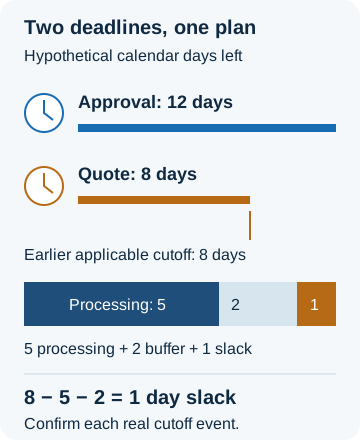
Use the earlier applicable deadline when both a current approval and a valid quote are required. Ask which event must happen before expiry: an order placed, accepted, shipped or invoiced. Record the applicable time zone and whether a renewal must be requested before expiry. Do not assume the approval period also fixes quote validity, stock allocation or delivery dates.
For schedule planning, define Dₐ as calendar days remaining to the approval cutoff and Dq as days remaining to the quote cutoff, both measured from the same date. Let P be your estimated processing time to the required event and B your internal buffer. Planning slack S = min(Dₐ, Dq) − P − B. Convert business-day estimates to the same calendar basis before calculating.
Hypothetical example: approval has 12 calendar days left, quote has 8, your estimated processing takes 5 and you allow a 2-day internal buffer. S = min(12, 8) − 5 − 2 = 1 calendar day. These assumed inputs illustrate the method; they are not vendor terms or an approval-time forecast.
If S is zero or negative, seek an extension, a refreshed quote or a revised customer commitment before relying on the benefit. A renewal request remains pending until confirmed. At close-out, archive the accepted BOM, approval, quote, order and delivery references, and update the opportunity through the applicable program process.
Compare total acquisition cost over the same project scope and support period: equipment and licenses plus freight, tax, support and expected rework costs, less only confirmed applicable benefits. Include time spent revising expired quotes, replacing unsupported substitutions and reconciling split shipments. Registration does not establish a lower lifecycle cost by itself.
Keep US procurement and equipment compliance review separate
A project-pricing approval is a commercial decision. It does not certify a camera, network device, distributor or contractor as NDAA compliant. For a US federal project, retain a separate contract and equipment review with the responsible procurement or compliance owner.
Section 889 of the FY2019 NDAA, enacted August 13, 2018, distinguishes federal procurement restrictions from restrictions on contracting with an entity that uses covered equipment or services. FAR 52.204-25, clause dated November 2021, identifies the respective August 13, 2019 and August 13, 2020 starting dates and includes scope definitions, exceptions and waiver references. This is a federal contracting framework; a registration reference cannot establish satisfaction of its requirements.
FCC equipment authorization addresses a separate question. The FCC’s final rule published November 25, 2025, effective December 26, 2025, discusses restrictions and review procedures involving covered equipment under its authorization program. Check the current applicable FCC rules and equipment records for the exact product. Neither project approval nor absence of a warning on a directory profile establishes equipment authorization or procurement eligibility.
Request evidence tied to the actual manufacturer, model, proposed delivery and contract clauses. Do not convert a distributor’s general marketing statement into a project-wide certification. The directory verification policy describes company-research labels, not compliance approval.
Prepare your distributor handoff
Use the distributor-finding guide to shortlist a relevant trading company. Request a quote from your chosen distributor using the completed packet: program and market, reseller identity, customer/project, current BOM revision, requested schedule and any existing registration or quote reference. Ask it to confirm the responsible submitter, missing inputs, current decision, accepted revision and applicable deadlines.
Keep customer details and pricing out of public directory submissions. DistributorIndex helps you research companies; your chosen vendor and distributor handle registration decisions and commercial quotations.
Method, sources and update date
Updated October 19, 2026. Compiled from public originals: Axis’s Project registration step by step guide, page 1 (2023 copyright), and the AXIS Site Designer manual, Request project pricing section; plus the program-scope statement on Fortinet Federal deal registration. All were retrieved October 19, 2026. Program examples establish their own published scope, not common terms across all vendors.
Regulatory references: Public Law 115-232, Section 889, FAR 52.204-25, and the FCC’s November 25, 2025 final rule, FCC 25-71. These references explain separate review boundaries; this guide does not determine a particular transaction’s legal status.
The packet, order-release rule and schedule calculation are editorial working tools. The numerical example uses stated assumptions. Private portal fields, current regional eligibility, discounts, protection periods and exception decisions require confirmation from the relevant program. No customer opportunity or private account was accessed.